P4C and Ethical Decision-Making
As a bilingual practical philosopher, Karin has extensive experience using the below philosophical methodologies with people from all socio-economic, racial and ethnic backgrounds worldwide. Her audience includes teachers, children of all ages, school advisors, university lecturers, professionals such as bankers, accountants and fire-fighters, retired women, detached youth workers, social and community workers and disaffected young people living on the streets of London and Bristol.
P4C: Philosophical enquiry with Children, Communities, Companies and Counselling
P4C is suitable for all levels of education until university and beyond. Its goal is to enact the theories and practices of philosophical enquiry in schools, universities, counselling, business and other professional or home settings.
The Community of Multispecies Philosophical Enquiry (COMPE)
Although COMPE may seem similar to research methods like focus groups or small group interventions, its vitality stems from asking open-ended philosophical questions. These questions require us to unlearn how we have been taught not to question in school or during childhood or whenever others assume authority over what can be claimed as knowledge. COMPE operates on the basis of radically open and philosophical listening. In hierarchical settings, there is often only ‘one right answer’ to questions – the answer that the educator, parent, manager, boss or project leader ‘in charge’ holds. In contrast to these closed questions that aim for the reproduction of knowledge, open questions resist having one single answer – they are divergent and generative, encouraging further questioning.
The key concept behind COMPE is not only to provide openings for the human to respond but also to create space for the non/more/other than human, including objects, animals, dead beings and whole fields of enquiry to participate in asking open philosophical questions about core concepts that are either explicitly used by speakers or already assumed in their claims to knowledge and truth. By asking ‘the prior question’ and letting questions cascade, COMPE slows down the thinking process, enabling more response-able living and dying. COMPE draws inspiration from children’s childlike inclination to question and engage playfully with the world without essentialising, generalising or romanticising children.
Karin’s COMPE-tence
The democratic Community of Philosophical Enquiry pedagogy was the focus of her PhD (1997) and continues to be a central element in her teaching, leadership style and research methodology. She has infused the methodology with the democratic principles of the Reggio Emilia approach (2016, 2017) and, more recently, with a posthumanist, multispecies dimension (2022, 2025). Karin is one of the founding members of the British charity SAPERE in Philosophy for Children (P4C)(1992) and has served as president of the International Council of Philosophical Inquiry with Children (ICPIC) between 2014-2016. She also founded and led the Southern African Philosophy for Children Network and remains involved in training educators in South Africa. Her mentors include Matthew Lipman and Ann Margaret Sharp in the U.S., founders of P4C whom she studied under in the United States.
Ethical Decision-Making
Karin has a background in academia and previously worked as the director of an educational consultancy. In this role, she oversaw finances, recruitment and staff management while facilitating in-service training for schools (see above). She organised outdoor government interventions with children and young people at risk, and integrity training for centres at universities, businesses and civil servants. As a qualified Integrity Trainer at the European Business School of the University of Nijenrode (NL) in 2003, Amsterdam Council recruited her as part of a large team managing change for its 23,000 employees. As an intervention to develop an organisation’s core values, combat fraud and corruption and decrease stress in the workplace, her work with accountants and the fire service has enriched her experience, which she has applied to educational contexts. She has led ethical decision-making courses and interventions with audiences as diverse as Directors of Centres of Learning and Teaching (CELTs) at universities in England, primary-aged children (Murris, 2004) and student teachers (Murris, 2012, 2014). The ethical decision-making course she currently teaches to student teachers gives a unique insight into school governance. Since 2020, her ethical decision-making approach has also included the non/more/other than human.
Additionally, she has been accredited by the International School voor Wijsbegeerte (ISVW) in the Netherlands as a Socratic dialogue facilitator since 1993.
Death and Dying
Karin is currently leading a project called Small Matters that focuses on multispecies death and dying, funded by the Research Council of Finland (2023-2027). This project, involving young children’s philosophical ideas about death and dying, informs her philosophical consultancy on death and dying with individuals and small groups.
Consultancy
Karin offers private consultations in English and Dutch for institutions, companies, and individuals. She also provides training courses at Levels 1-3 in Philosophical Enquiry with Children for formal and informal educators (see below).
Accredited Philosophy with Children Courses – Levels 1, 2, 3 & mentoring
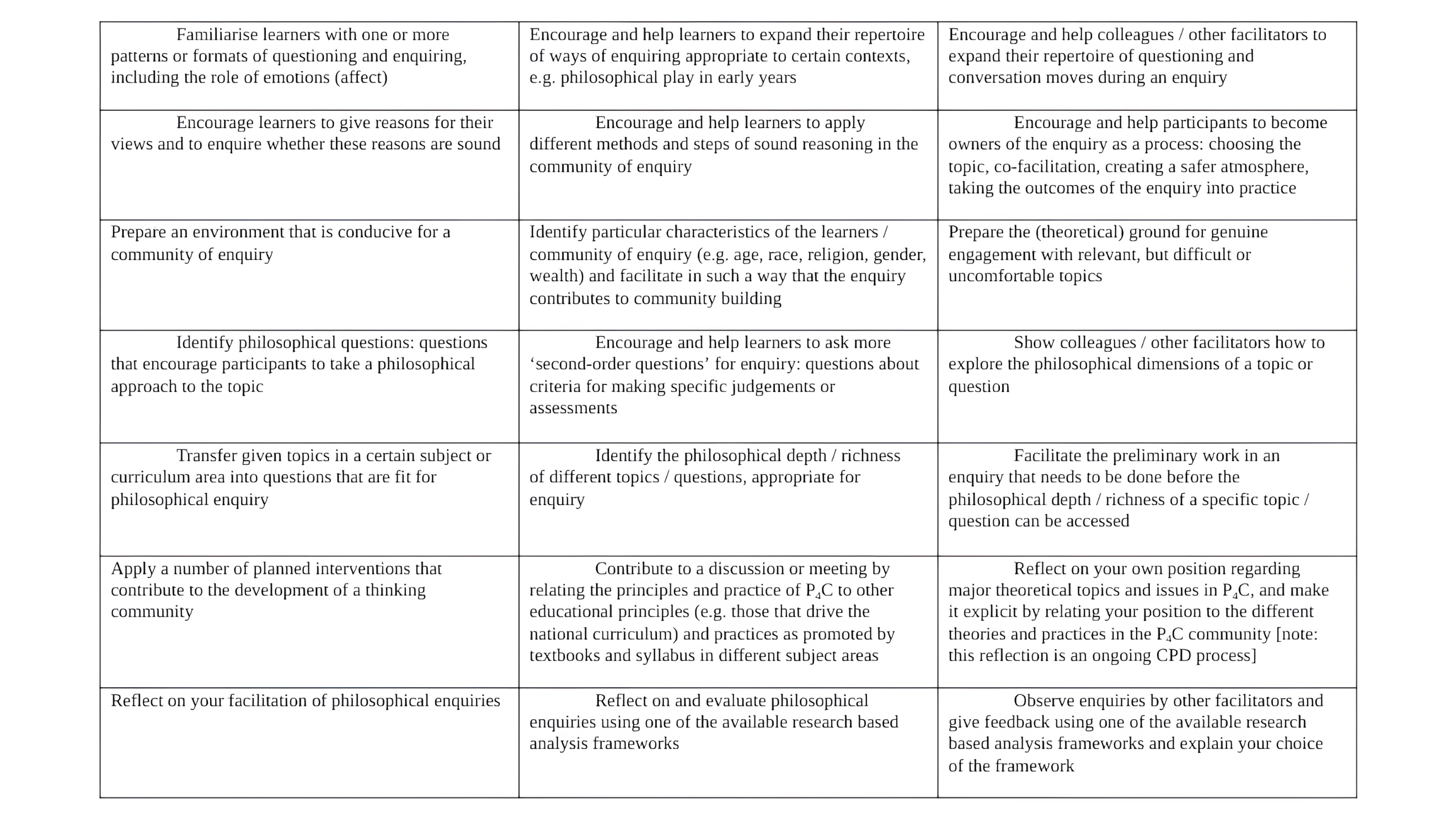
The higher levels focus on developing facilitation skills and increasing contextual sensitivity to better support others in implementing this approach. After completing Level 3, individuals can continue learning through experience, reflection, mentoring, apprenticeships and collaboration with colleagues. To become a trainer themselves, they must undergo a mentoring process after completing Level 3 and will receive support when leading their first in-service courses.
The underlying idea in the progress from Level 1 up to Levels 2 and 3 is that the higher levels focus on developing facilitation skills and increasing contextual sensitivity to better support others in applying this approach.
All three levels comprise two workshops of about 10-12 hours each, with written reflections in between.
There is still a lot to learn after Level 3, through experience, reflection, mentoring, apprenticeships and exchange with colleagues. To become a qualified trainer yourself, you must undergo a mentoring process after completing Level 3. You will receive support when leading your first in-service courses.